Agentic networks: many AI agents that learn and act together
A 5-minute primer on what agentic networks are, why they matter, how they work, and the algorithmic questions my group works on.
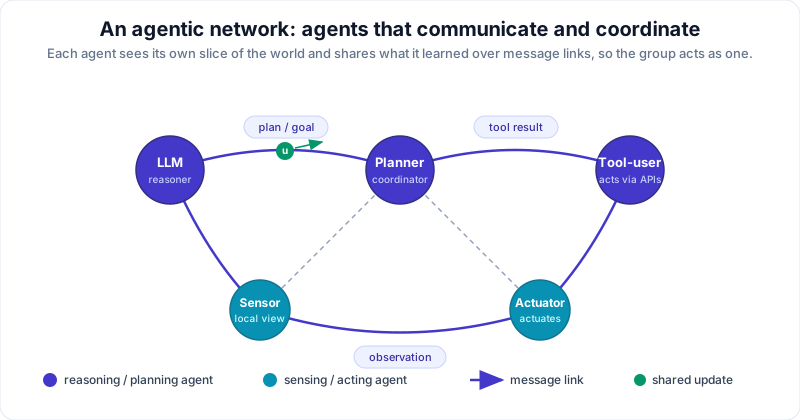
The next wave of intelligent systems will not be a single, monolithic model behind an API. It will be many AI agents, including LLMs, planners, tool-users, sensors, and controllers, talking to each other to act in the world. This page is a quick tour of where the field is heading, and where my recent research fits in.
What is an agentic network?
An agentic network is a system of AI agents that communicate, coordinate, and learn together to accomplish tasks that no single agent can solve alone. Each agent gathers its own observations, acts in its own slice of the world, and exchanges messages with peers to share what it has learned. The unit of intelligence is the network, not the individual agent.
The basic primitive is not “make a prediction” but “share what you learned, decide what to do next.” Almost every interesting question about agentic networks reduces to one: how should agents exchange information so the group learns and acts as efficiently as possible, under bandwidth, privacy, and heterogeneity constraints?
Why agentic networks?
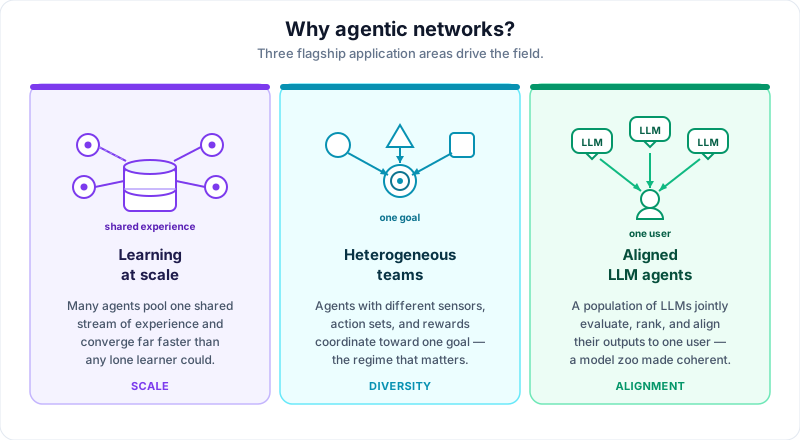
Three application areas drive the field, and they map onto three technological frontiers.
1. Learning at scale: many agents, one shared experience
A single agent learns from a single stream of data. A population of agents can pool experience and converge much faster, the AI analogue of how distributed training scales by interconnect rather than by model size. This is one of the more plausible paths to learning agents that adapt to new environments in minutes rather than days.
2. Heterogeneous teams: different sensors, different skills, one goal
Real deployments mix agents with different observations, action sets, and rewards: a recommendation system with users who like different things; a sensor network whose nodes see overlapping but distinct slices of the environment; a team of LLM agents specialized for different tools. Coordinating heterogeneous agents is harder than coordinating identical ones, and it is the regime that matters in practice.
3. Aligned LLM agents: many models, one user
As LLM agents proliferate, which response should be served, and which agent’s feedback should be trusted? Agentic-network methods let a population of LLMs jointly evaluate, rank, and align their outputs to a particular user, turning a fragmented model zoo into a coherent assistant.
How do agentic networks work?
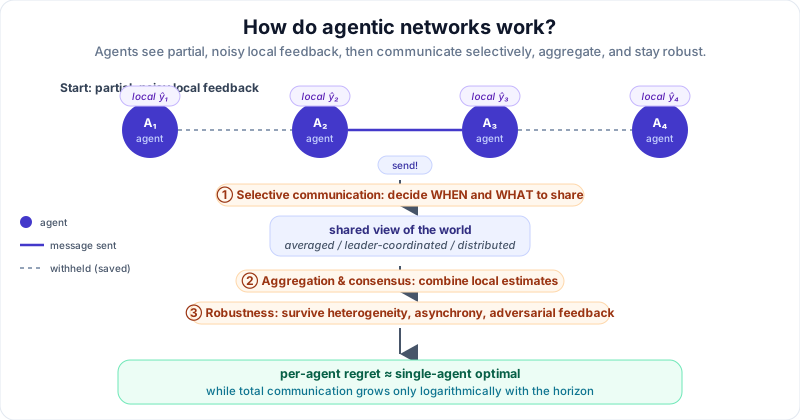
The central obstacle is the cost of communication. Naive “tell everyone everything every round” scales quadratically in agents and saturates any realistic link. Agents also see partial, noisy feedback, and what they observe is often correlated with the messages they receive, which breaks the independence assumptions that make single-agent learning tractable.
The fix is a small set of design primitives that recur across cooperative learning:
- Selective communication. Agents decide when and what to share, often by message-saving triggers tied to how informative an observation is.
- Aggregation and consensus. Local estimates are combined, whether averaged, leader-coordinated, or fully distributed, to form a shared view of the world.
- Robustness to heterogeneity and adversaries. Protocols must survive agents with different reward distributions, asynchronous clocks, or maliciously corrupted feedback.
Stitching these primitives together yields cooperative algorithms whose per-agent regret matches single-agent optimal while total communication grows only logarithmically (or better) with the horizon, the substrate of a scalable agentic network.
Where my research fits
The vision above leaves a stack of algorithmic questions open. Agents have bounded bandwidth. They disagree on what they see. They run on different clocks. Some are adversarial. Some are LLMs whose feedback is human and noisy. My recent work addresses four of these.
Communication-efficient cooperation: near-optimal regret on a budget
When can a group of cooperating learners match the regret of a single learner with all the data, without flooding the network? We design protocols whose communication cost grows much slower than the regret it saves, and analyze the tradeoff between the two.
- Asynchronous Multi-Agent Bandits: Fully Distributed vs. Leader-Coordinated Algorithms (SIGMETRICS 2025). Drops the lock-step assumption common in multi-agent bandit analyses and clarifies the communication-versus-regret tradeoff for cooperating learners.
- Federated Multi-armed Bandits with Efficient Bit-Level Communications (NeurIPS 2025).
- Achieve Near-Optimal Individual Regret & Low Communications in Multi-Agent Bandits (ICLR 2023).
- On-Demand Communication for Asynchronous Multi-Agent Bandits (AISTATS 2023).
Heterogeneous and asymmetric cooperation: when agents do not see the same world
Real teams are not identical. Agents may have different reward distributions, different observation models, or only partial knowledge of each other’s existence. We characterize when heterogeneity helps (exploration for free) and design algorithms that exploit it.
- Heterogeneous Multi-Agent Multi-Armed Bandits on Stochastic Block Models (SIGMETRICS 2026).
- Heterogeneous Multi-Agent Bandits with Parsimonious Hints (AAAI 2025).
- Optimal Regret Bounds for Federated Multi-armed Bandits with Fully Distributed Communication (UAI 2025).
- Exploration for Free: How Does Reward Heterogeneity Improve Regret in Cooperative Multi-agent Bandits? (UAI 2023).
Scalable agent grouping and shareable policies: when resources, not agents, are the bottleneck
In large agentic systems, multiple agents often want to use the same resource: an arm, a server, a tool. We design algorithms for shareable arms and resource-aware cooperation, where the right unit of optimization is the resource rather than the agent.
- Online Learning for Ski-Rental Problem (Preprint).
- Multiple-Play Stochastic Bandits with Shareable Finite-Capacity Arms (ICML 2022).
- Multi-Player Multi-Armed Bandits with Finite Shareable Resources Arms (IJCAI 2022).
Aligning LLM agents from interactive feedback: a population of models, a single user
When the agents are LLMs and the feedback is human, the problem becomes: which response, from which model, should the user see? We cast this as an online learning problem over a conversational multi-agent system that jointly evaluates and selects user-aligned responses.
- A Multi-Agent Conversational Bandit Approach to Online Evaluation and Selection of User-Aligned LLM Responses (AAAI 2026). An online algorithm for selecting user-aligned LLM responses from a population of agents under interactive feedback.
Together these threads build toward an algorithmic foundation for networked AI agents: how to learn, communicate, and align in a world where intelligence is collective and feedback is noisy. If this interests you, come build it with me.