Quantum networks: moving qubits and entanglement, not bits
A 5-minute primer on what quantum networks are, why they matter, how they work, and the algorithmic questions my group works on.
The internet you are reading this on moves bits. The next one will also move qubits and entanglement, a different kind of resource that supports computing, sensing, and security guarantees no classical network can match. This page is a quick tour of where the field is heading, and where my recent research fits in.
What is a quantum network?
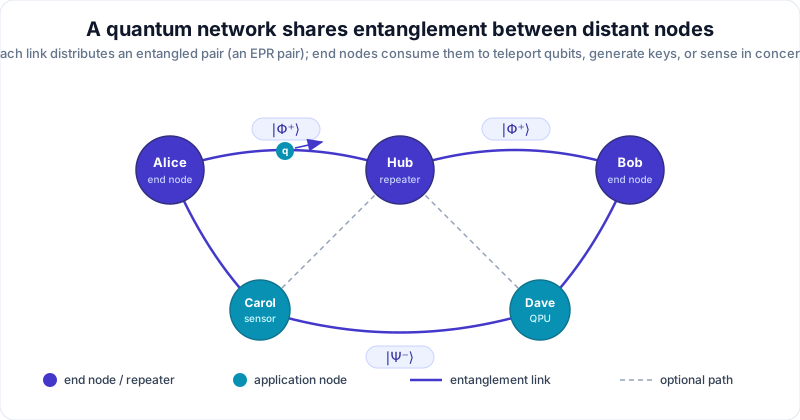
A quantum network is communication infrastructure for transmitting quantum information, meaning qubits and, above all, entanglement, between distant nodes. Where classical networks shuttle 0s and 1s, quantum networks use superposition and entanglement to enable capabilities that are provably impossible in a classical world.
The basic primitive is not “send a bit” but “share an entangled pair between two remote nodes.” Once two nodes share entanglement, they can teleport qubits, generate shared secret keys, or coordinate measurements with sub-classical noise. Almost every application of a quantum network reduces to one question: how do we deliver high-fidelity entanglement, where it is needed, when it is needed?
Why quantum networks?
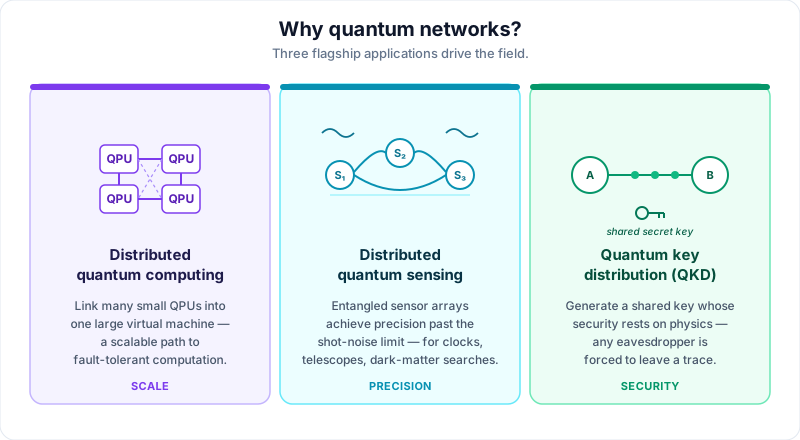
Three applications drive the field, and they map onto three technological frontiers.
1. Distributed quantum computing: scaling beyond a single chip
A single quantum processor is bounded by how many qubits it can host coherently. Networking many smaller processors via entanglement turns them into a single, larger virtual machine, the quantum analogue of how classical data centers scale by interconnect rather than by chip size. This is one of the more plausible paths to fault-tolerant, large-scale quantum computation.
2. Distributed quantum sensing: precision past the shot-noise limit
Distributing entangled states across an array of sensors lets them measure in concert, reaching precision beyond what any classical sensor network can achieve. Applications include gravitational-wave detection, dark-matter searches, clock networks, and long-baseline interferometry.
3. Quantum key distribution: security guaranteed by physics
QKD lets two parties generate a shared secret key whose security rests on the laws of quantum mechanics: any eavesdropper must disturb the channel, and that disturbance is detectable. This is information-theoretic security. It does not break when the adversary buys a bigger computer (or a quantum one).
How do quantum networks work?
The central obstacle is the no-cloning theorem: unknown qubits cannot be copied, so classical signal amplification is off the table. Photons sent through optical fiber are lost exponentially with distance, which rules out any naive long-haul link.
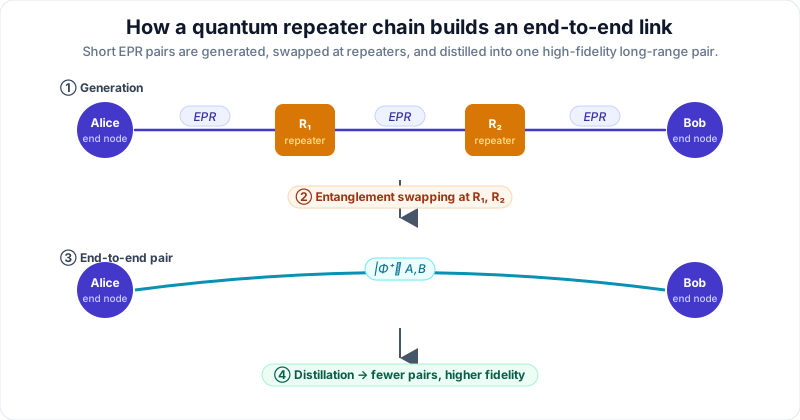
The fix is the quantum repeater. A long link is broken into short segments, and three primitives are chained together:
- Entanglement generation. Neighboring nodes establish short-range entangled pairs.
- Entanglement swapping. A middle node fuses two short pairs into one longer-range pair.
- Entanglement distillation. Many noisy pairs are consumed to produce fewer high-fidelity pairs.
Stitching repeaters together extends entanglement to continental and ultimately global scales, the substrate of a future quantum internet.
Where my research fits
The hardware story above leaves a stack of algorithmic questions open. Link fidelities are noisy, drift over time, and are never known up front. Repeater memories are scarce. Probes that measure the network consume the resource being measured. My recent work addresses two of these.
Quantum routing: finding good entanglement paths under uncertainty
Even with a working repeater network, which path should you use to connect Alice and Bob? Path fidelity depends on every link, and link fidelities are unknown and time-varying. We cast this as an online learning problem: probe paths, observe noisy outcomes, and converge on a near-optimal path while paying as little regret as possible.
- Learning Best Paths in Quantum Networks (INFOCOM 2025). An online algorithm for entanglement-path selection with provable regret guarantees under unknown, noisy link fidelities.
- LinkSelFiE: Link Selection and Fidelity Estimation in Quantum Networks (INFOCOM 2024). Joint link selection and fidelity estimation as a building block for routing.
Quantum network tomography: measuring the network you cannot observe classically
Before you can route well, you need to know the network: link fidelities, decoherence rates, error parameters. But every probe consumes entanglement, probes interact in non-trivial ways across shared links, and the measurements themselves are noisy. Quantum network tomography asks what can be identified from probe data, and how a limited probe budget should be allocated to learn it as fast as possible.
- Quantum Network Tomography for General Topology with SPAM Errors (preprint, 2025). Identifies and estimates per-link channel parameters on arbitrary network topologies while accounting for state-preparation and measurement (SPAM) errors.
- Online Optimal Probe Allocation for Quantum Network Tomography (QCNC 2026). An online probe-allocation algorithm that matches the offline optimum up to vanishing terms.
Together these threads build toward an algorithmic foundation for the quantum internet: how to learn, route, and measure on a network whose physics is unforgiving and whose state is never fully observable. If this interests you, come build it with me.